
Behind the Scenes
I Turned Watching Ants Haul Insects as a Kid into 20 New Game Levels
By the POMODIARY Team · · 6 min read
When I was little and living in the countryside, my favorite thing was squatting on the ground to watch ants move house.
A black line stretched from the foot of a wall all the way into the grass. The ones in front scouted the way, the ones behind followed in a queue, and when they ran into something big, a dozen or so would gather around it, lift it together and slowly shuffle it back to the nest. I could watch for a whole afternoon.
While making this game, the first five chapters were all food: sunny-side-up eggs, donuts, cakes, Lanzhou beef noodles... But looking back, the things I saw ants carrying as a kid were rarely anything like that.
In the countryside, what ants carried most was small insects: a grasshopper that had stopped moving, an earthworm, a cicada that had fallen to the ground. The one I remember best is the mole cricket, the insect that digs through the soil underground with front legs like two little shovels, and a crowd of ants surrounding it and dragging it home bit by bit.
So this time I made a sixth chapter, called "Wild Bites from the Grass."
This post was first written in Chinese for the developer's WeChat Official Account (a blog-style publishing channel inside the WeChat messaging app) and adapted for English readers. The screenshots show the Chinese interface. Crumb Colony is a browser puzzle game in which you release colored ants that eat a pixel-art picture block by block; the launch post explains the rules.

Chapter six, "Wild Bites from the Grass," levels 101–120
20 insects that ants really carry home
The 20 levels in this chapter are all things ants really do carry:
- Grasshopper, seven-spot ladybug, cricket, caterpillar, cicada
- Dragonfly, earthworm, cabbage white butterfly, praying mantis, chafer beetle
- Longhorn beetle, firefly, honeybee, dung beetle, moth
- Stick insect, swallowtail butterfly, rhinoceros beetle, stag beetle, and for the final level, a mole cricket in its tunnel
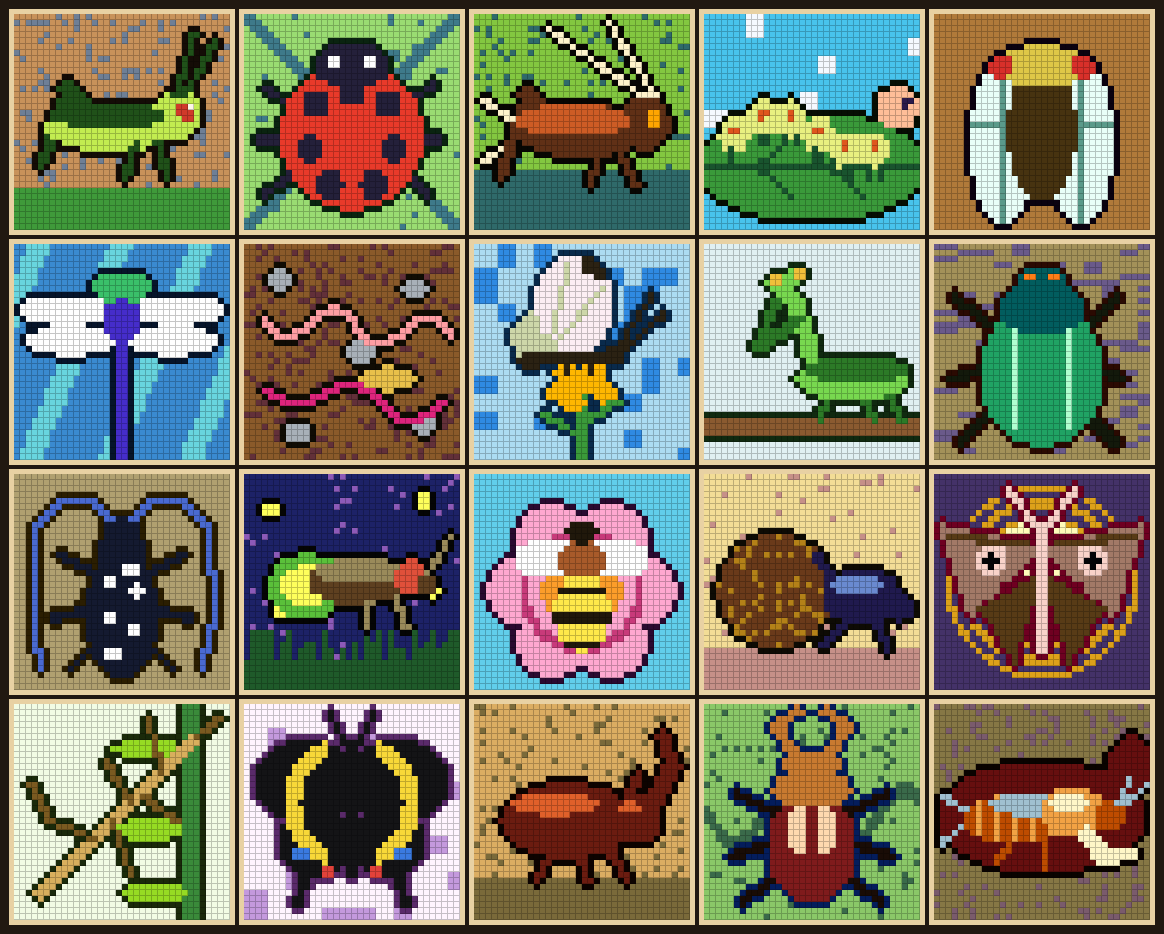
The 20 insects of chapter six
Each insect is drawn on a 36×36 grid, with a background of the place it usually lives: the grasshopper in the grass at the edge of a field, the cicada clinging to tree bark, the firefly in the grass on a summer night, the mole cricket in the tunnel it dug itself.
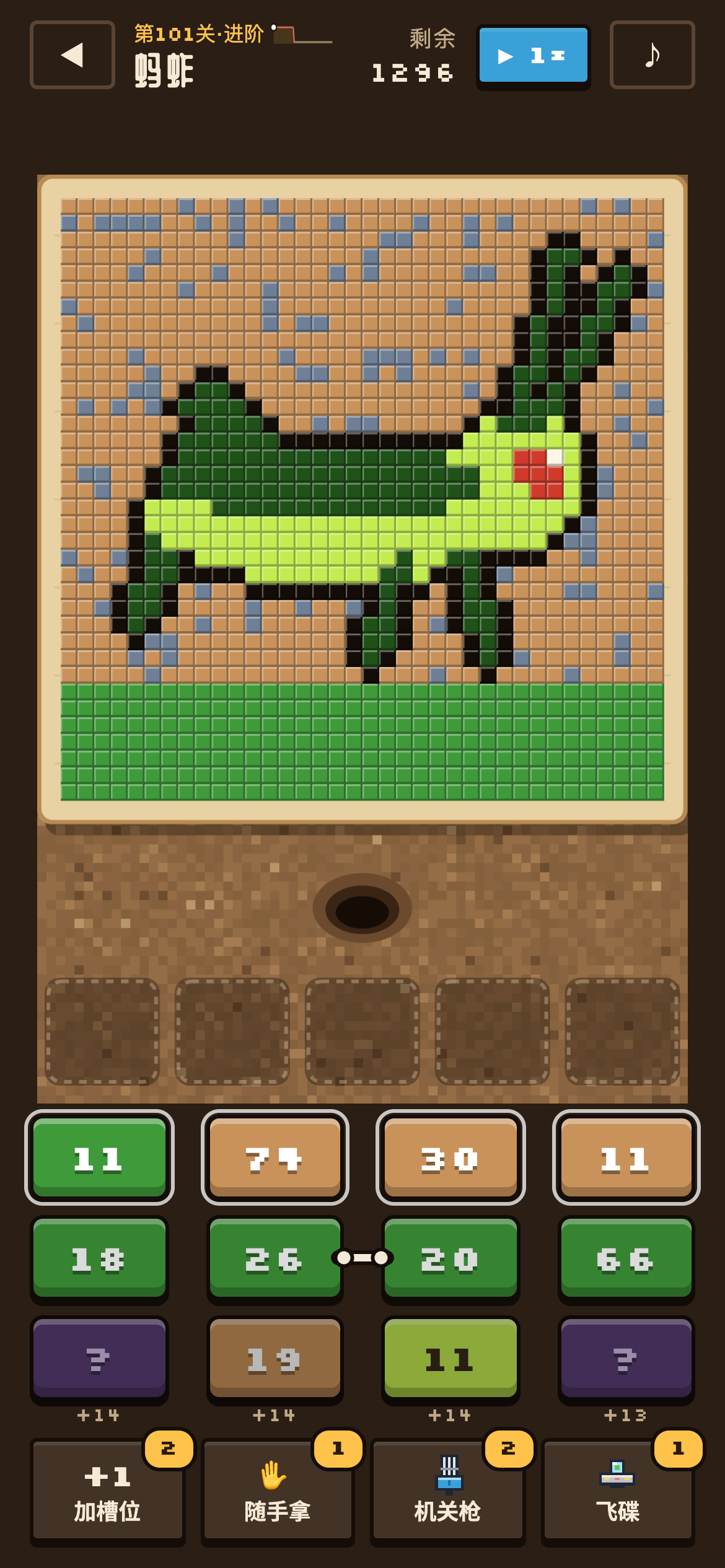
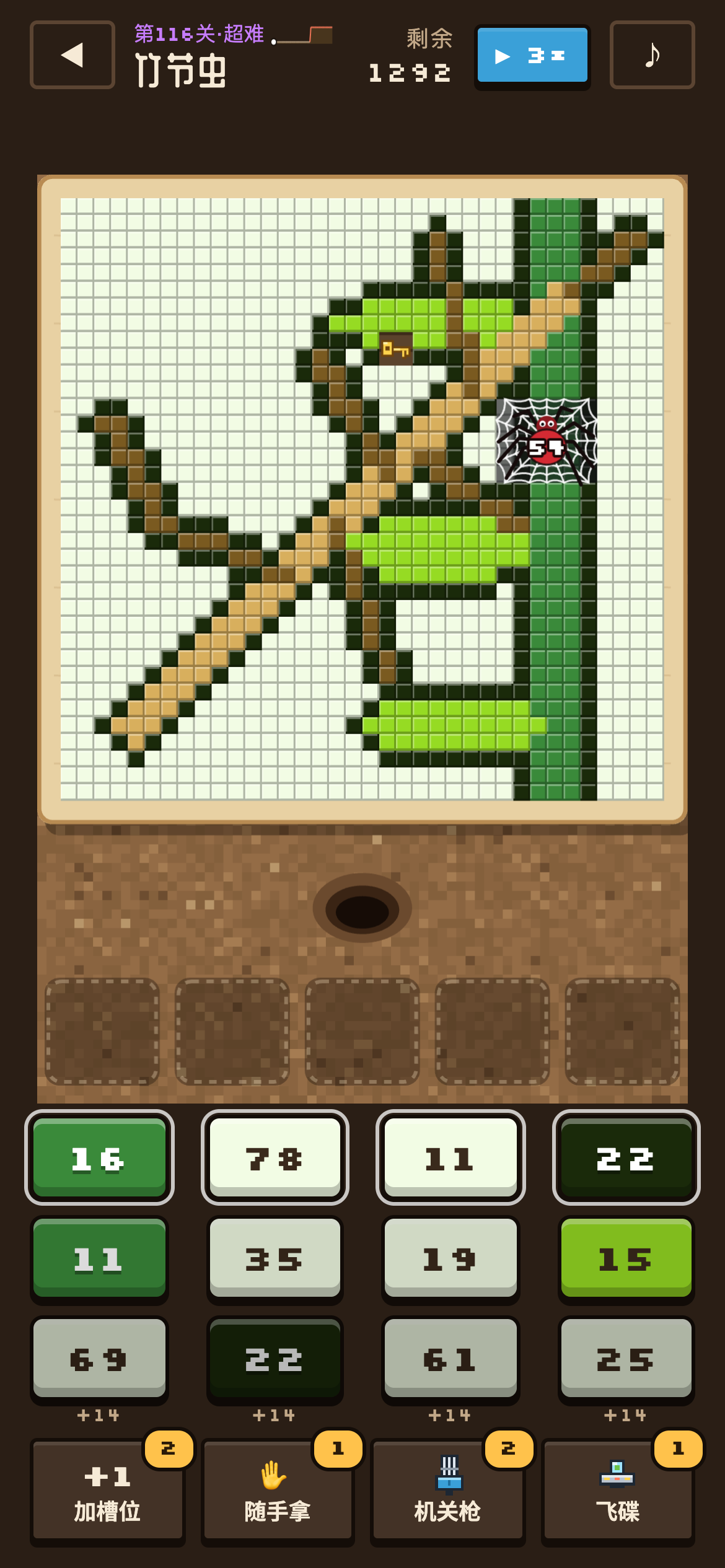
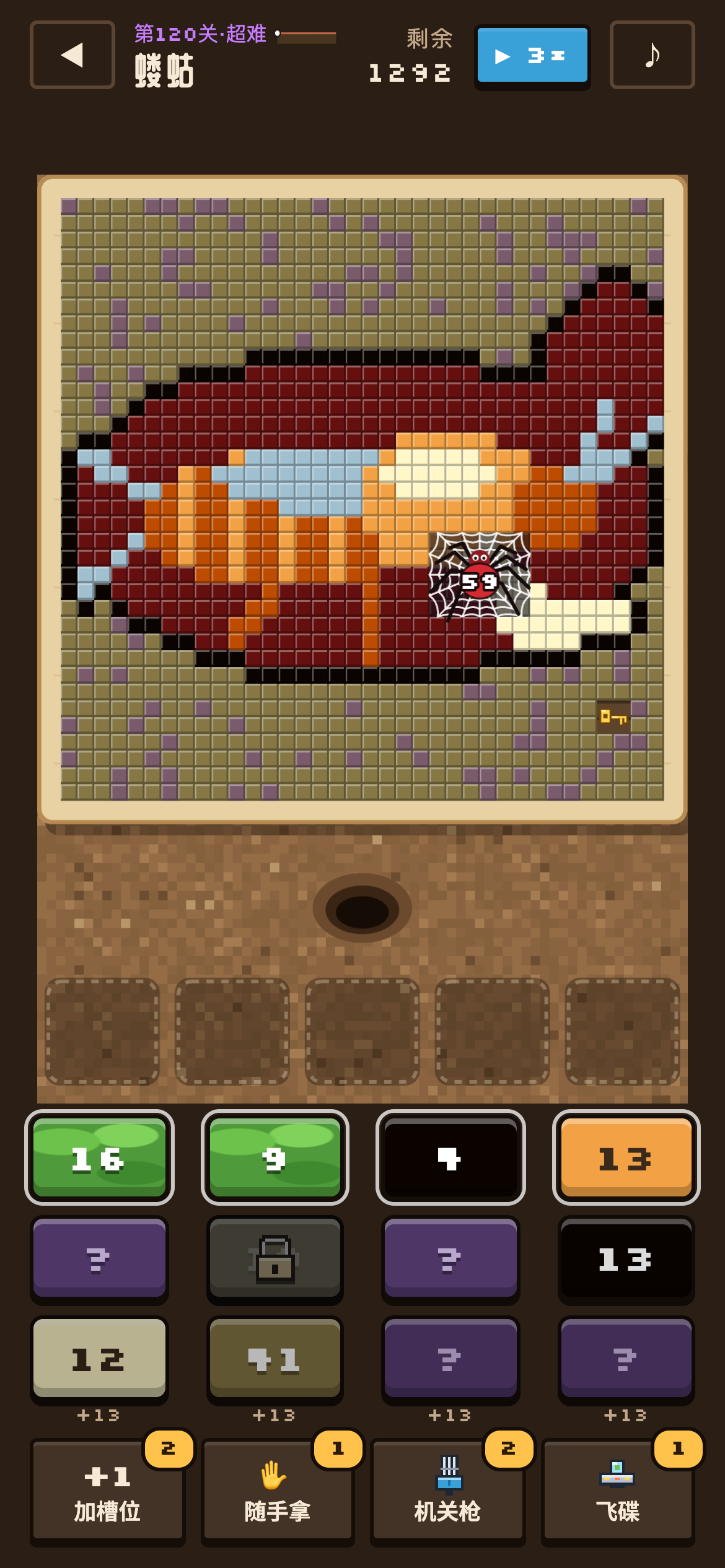
Level 101, grasshopper; level 116, stick insect; level 120, mole cricket
I deliberately made the stick insect level hard to recognize: it is lying on bamboo and looks almost exactly like a small twig.
In this chapter, many levels cannot be solved by reasoning
After the last update, people kept telling me the game was too easy: a few minutes per level, and the whole game finished in one evening.
So for chapter six I switched to a different kind of difficulty.
In this game's tray, you can only see the front three rows of each column. Below that, it only shows "how many boxes are left." In the first five chapters, most of the time you could stare at the few visible boxes, think it through, and find the right moves.
Chapter six is different: the key box that breaks the level open is often buried deep in one of the columns, where you cannot see it at all. Every box you take is really a choice of path. Only if you happen to pick the right path, and dig down that column in time, can you reach it when it matters most. Pick wrong and things slowly jam up from there.
Staring at the screen and reasoning will not get you there. All you can do is go down a path on instinct, and if it is wrong, restart and try another. Luckily, the boxes in a given level are the same every time, so you remember the paths you have tried and can always work it out a little at a time.
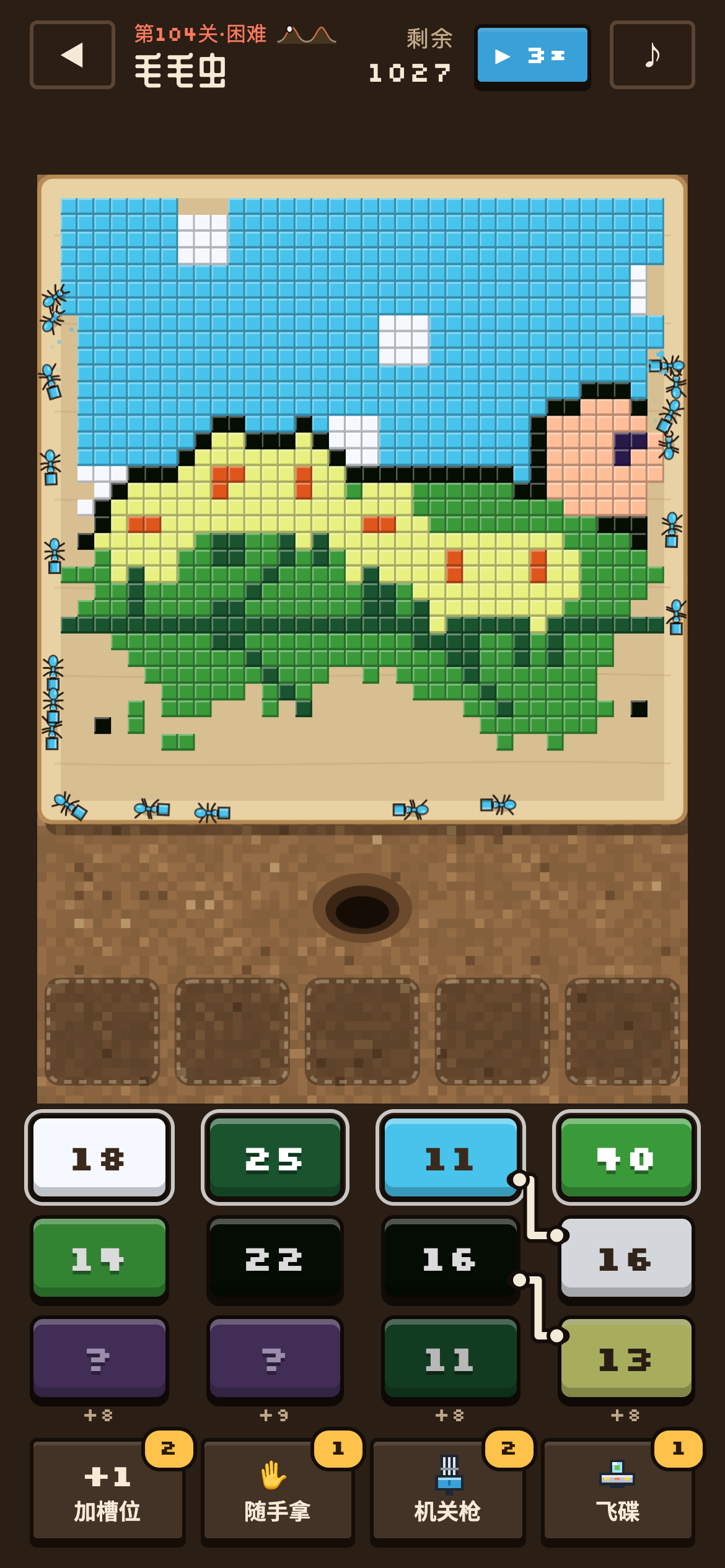
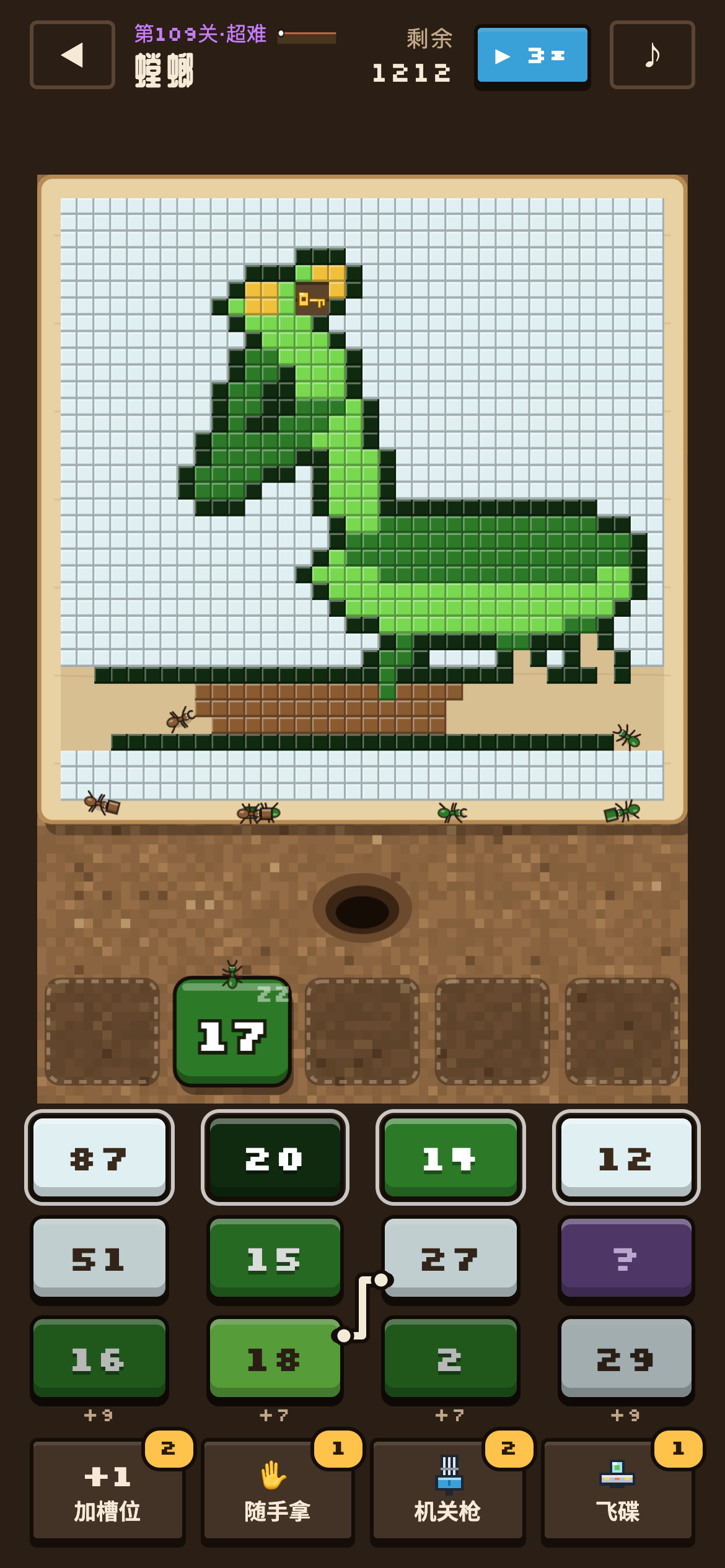
Level 104, caterpillar, and level 109, praying mantis, halfway through
How I built levels like this
To make levels that "cannot be solved by reasoning," you first need to know whether a level can be reasoned out at all. I measured that with a program.
The "expert" bot I used before to measure difficulty would simulate several moves ahead before deciding each step. But I later found it had a flaw: it could see the whole tray, even the boxes deep down. If it said a level was beatable, that did not mean a person could figure it out.
So I wrote another expert that can only see the front three rows. It also plays ahead, but the deep boxes are unknown to it, so it has to guess as it plans. How often this bot wins roughly represents "how much you can work out from the information on screen."
For every level in chapter six, I picked trays by this standard:
- The bot that can see the whole tray always gets through: every level is guaranteed to be solvable
- The expert that sees only the front three rows fails most of the time: reasoning alone cannot find the path
- An ordinary player who just picks any box that can eat also fails most of the time: casual play will not stumble onto it either
At first I picked trays only in the simulator, but when I tested them in the real game, a lot of the difficulty was diluted: in the real game, ants set off the moment they have something to eat, which is more forgiving than the simulation. So I changed the process. For each level, I first drew over a thousand trays in the simulator, picked a dozen or so, then put them into the real game and had the bots play game after game, choosing by the actual win rate.
A few levels were still too easy no matter what I picked, such as the dragonfly, the swallowtail and the longhorn beetle. For those, I added extra linked boxes, question-mark boxes and keys, and picked again.
Here is what the tests in the real game finally showed:
- The expert that can see the whole tray wins 52% of chapter six
- The expert that sees only the front three rows wins just 6% of chapter six (21% in chapter five)
- The ordinary player's win rate drops from 30% in chapter five to 23%
Seeing everything wins half the time; seeing only the front three rows almost never wins. That gap is exactly the path hidden in the depths, the one you can only find by trying.
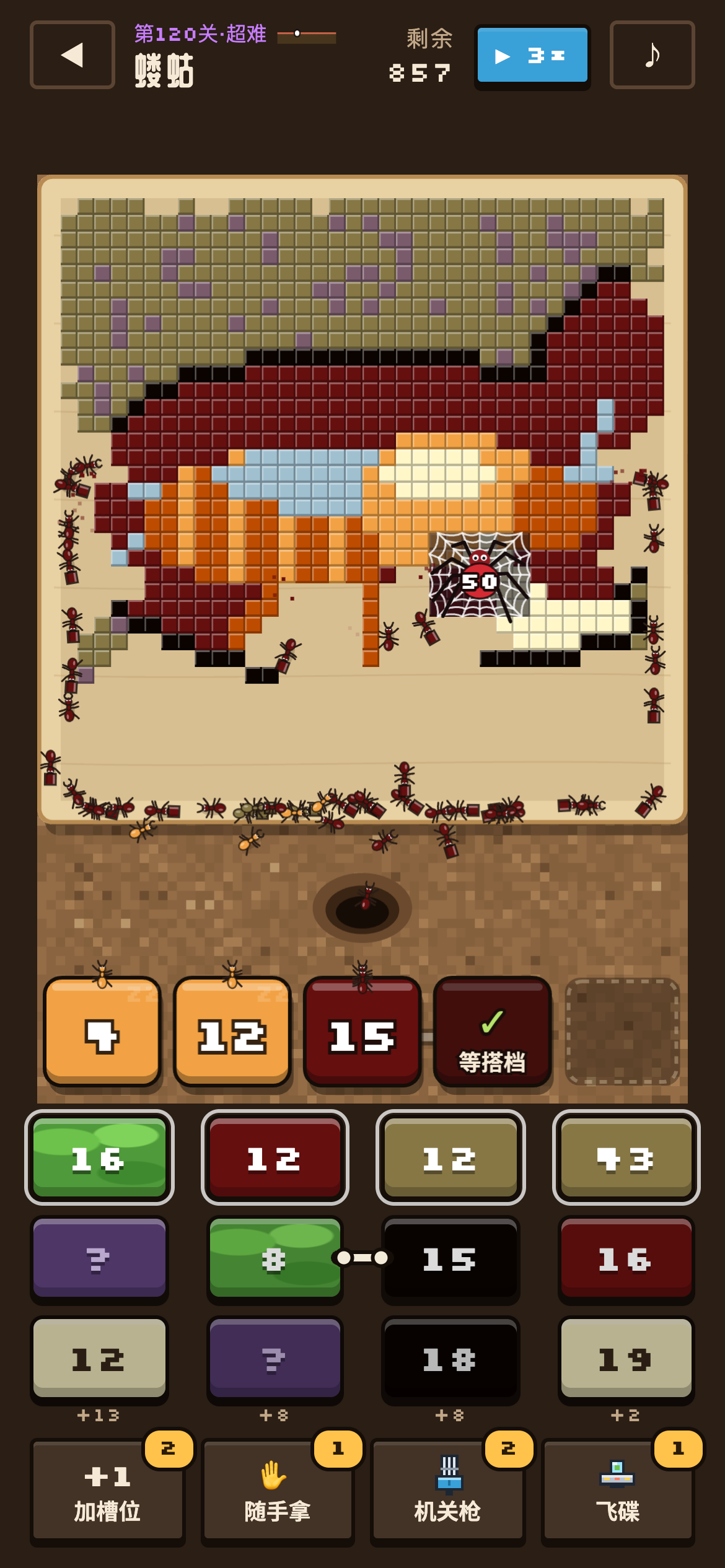
Level 120, the mole cricket, the final level
Every level can be beaten
Hard as it is, the bottom line has not changed: every level can be cleared without any power-ups. Before any level goes live, the program has to beat it once in the real game without power-ups. If even one level fails, the new version cannot ship.
Right after launch, someone told me they could not get past level 116, the stick insect. I was about to record a walkthrough video for them when they beat it on their own.
If you are truly stuck, the website has a walkthrough page for every level, with a complete set of steps to clear it. The "Extra Slot" power-up also helps a lot: with one more slot, you still have a chance to recover from a wrong move.
Go play
Open this in the browser on your phone or computer:
If you played before, your progress and stars are all still there. Finish the first 100 levels and you can play chapter six.
Keep reading
- I Made a Little Game About Ants Carrying Pixel Art Home, One Bite at a Time
Crumb Colony is a free browser puzzle game: release colored ants and watch them carry a pixel-art dish to their nest, bite by bite, across 20 solvable levels.
- A 100K-Download App Sat Quiet for Two Years. After a 13-Day Revamp, It Started Earning Again
Pomodoro Diary had 100K+ downloads but no real update in a year or two. We merged 53 PRs in 13 days to rebuild it, and paid orders started coming back in.
- I Asked AI to Stop a Dev Server. It Killed My Entire Browser, Twice
One pkill line on macOS took down Chrome, Claude and ChatGPT at once, twice in a week. The cause was argument order; a pre-command hook finally stopped it.