
Behind the Scenes
Bringing Nearly Lost Folk Games Back, Stroke by Stroke: Making the Folk Game Hall
By the POMODIARY Team · · 6 min read
Website: youxi.pomodiary.com
When we were kids, playing a game did not require buying anything.
You scratched a few lines on the ground with a twig, picked up two big stones from by your feet to be the "cannons", and grabbed a handful of pebbles or snapped a few short sticks to be the "soldiers". Then you squatted down and battled it out for a whole morning. No screen, no electricity, not even a sheet of paper. A patch of concrete and a few stones were all the equipment you needed.
But these games are quietly disappearing. There are fewer and fewer concrete threshing grounds (the flat yards where rural families dry grain, which doubled as playgrounds), children now hold phones instead, and there are fewer and fewer old people who can still recite the rhymes and are willing to squat on the ground and teach their grandchildren to play. These games never made it into any book of game records and will never feature in a tournament. They look set to die out with our generation.
So I made the Folk Game Hall (乡土游戏馆): bringing these games once scratched into the ground onto the web, one by one.
This post was first written in Chinese by the developer and adapted for English readers.

What it is
It is a collection of folk games that is free, needs no login, and is playable the moment you open it. Every game supports two people playing against each other, and you can also challenge the computer. It is available in five languages: Simplified Chinese, Traditional Chinese, English, Japanese and Korean.
Six games are playable right now: Cannons vs. Soldiers, Tigers and Sheep, the sliding number puzzle (Huarong Road), Watermelon Chess, Sanxie Qi and Gomoku, with more to be added over time.
Building this site, there were a few things I simply could not let go of.
Obsession one: make it "real", not cartoonish
At first I drew the pieces with gradients and rounded corners. They looked clean enough, but something always felt wrong: they were "drawn", not real things.
The soul of a folk game lies precisely in its rough realness. So I tore down the whole visual design and started over. The board became a patch of packed earth, with the grid lines as shallow grooves scratched into the soil with a twig, crooked and wobbly. The cannons are two oddly shaped real stones, and the soldiers are twelve little sticks with the bark still on. Everything uses real photographic textures, and even the outlines of the stones are irregular, as if they had just been picked up off the ground.
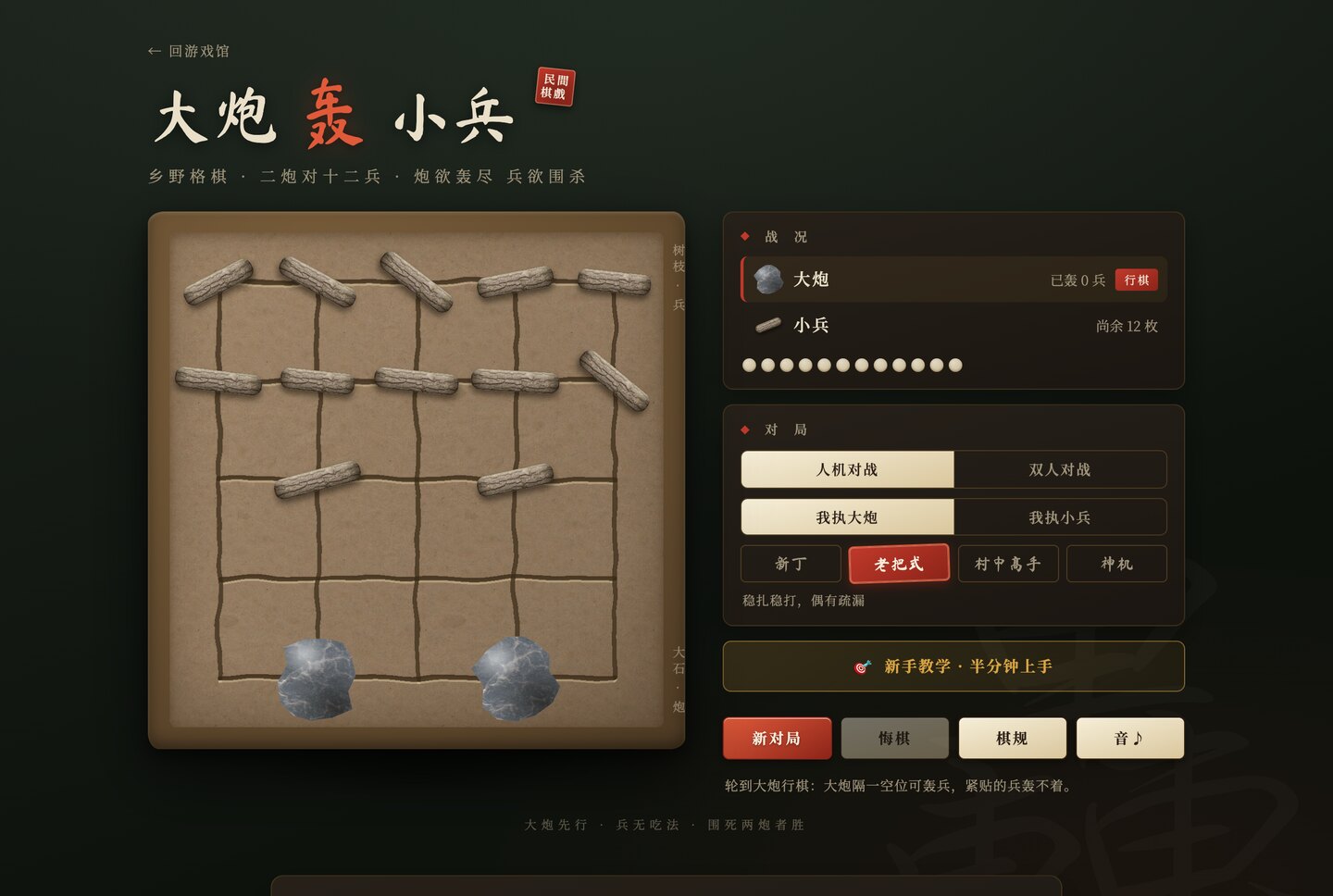
A stone jumps over an empty point to blast away a stick, kicking up a puff of dust. That is how the game looks in my memory.
Obsession two: the computer has to be genuinely "smart"
I really dislike games where you can beat the "vs. computer" mode at a glance. So at the highest difficulty, I wanted it to be smart enough that an ordinary person basically cannot beat it.
This turned out to be harder than I expected. Take Cannons vs. Soldiers: by the rules, the soldiers have the numbers, and if you play seriously the soldiers are actually bound to win. However strong the computer is, playing the cannons it cannot turn the game around, which ruins the game. So I had the computer play against itself again and again while I tuned the parameters, until both sides had a real chance of winning.
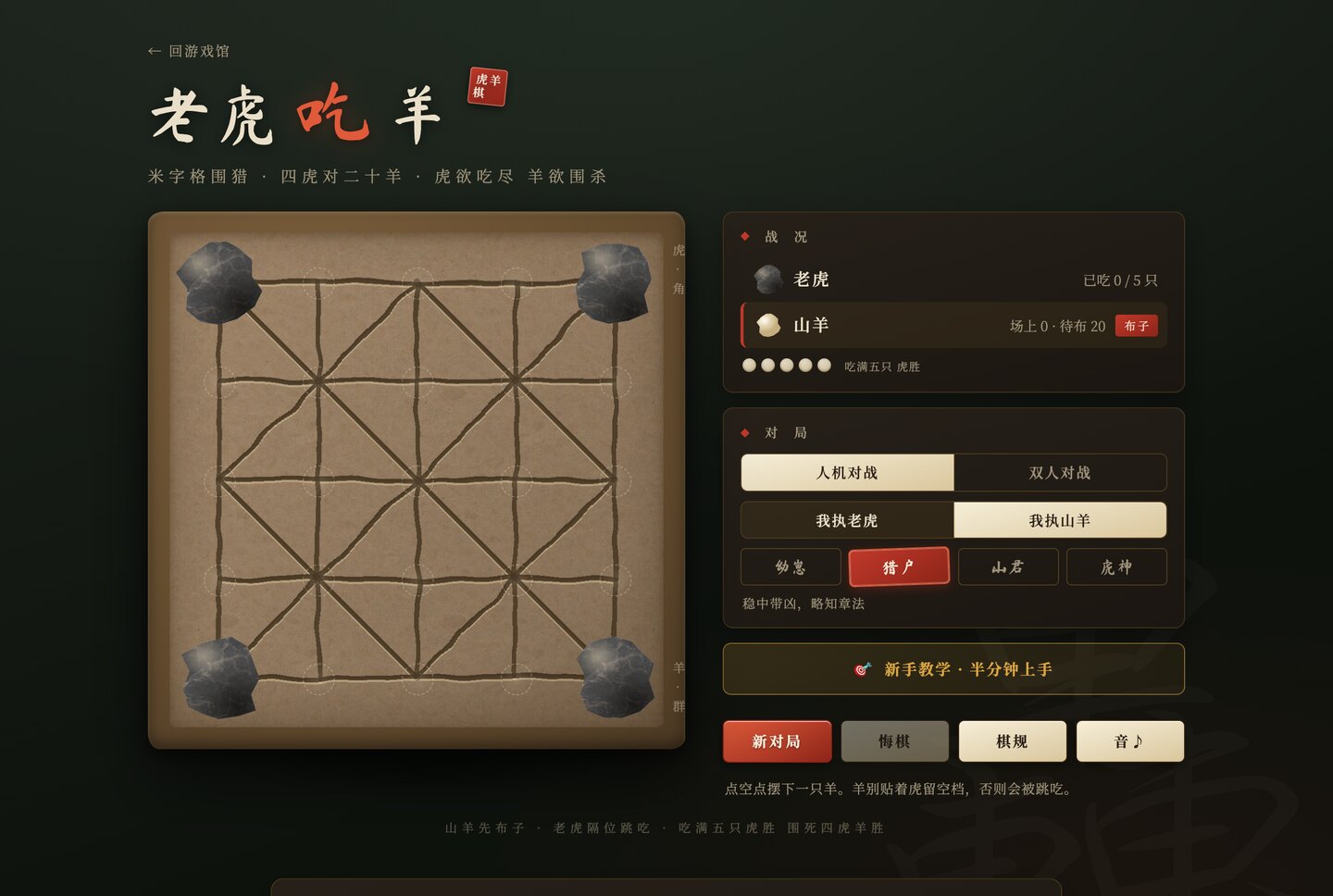
Tigers and Sheep was an even clearer case. With two tigers, the tigers simply could not be trapped, nor could they eat enough sheep; however I tuned it, the game was lopsided. In the end I switched to the most classic and most balanced variant, "four tigers and twenty sheep on the 米-shaped grid" (a board with diagonals crossing every square, shaped like the character 米). The sheep must first be placed one at a time, and every placement risks being jumped and eaten, yet once all twenty sheep are on the board they are enough to weave a net that traps the four tigers. Only then are attack and defense evenly matched, and whoever calculates deeper wins.
Obsession three: more than a game, a piece of culture
While researching, I made a surprising discovery: these rustic old board games actually belong to a worldwide family of games.
Asymmetric hunting, where "one side is few but strong and the other many but weak", is an ancient theme shared across humanity. Tigers and Sheep is almost the same game as Nepal's Bagh-Chal (Tigers and Goats). It is also related to Europe's Fox and Geese and to the king's table game of the Norse Vikings. A few stones and a few scratches in the dirt, and a mountain village is playing the same contest of wits as places thousands of miles away. That is the most moving thing about folk games.
So at the bottom of every game page I wrote detailed rules, the game's history, and "memories from back then". It is there for search engines, but even more so because I want to preserve this culture along with the games.
The Mona Lisa on that Nokia screen
When it comes to memories, the sliding number puzzle hits me hardest.
Back in the day, Symbian phones (the operating system on Nokia handsets before smartphones took over) came with a preinstalled sliding puzzle that cut a famous painting into squares. People slid tiles secretly in class and under the covers at night. The Mona Lisa was probably a shared "first puzzle love" for several generations. I recreated it one to one, right down to that maddening feeling of being "just one tile away".
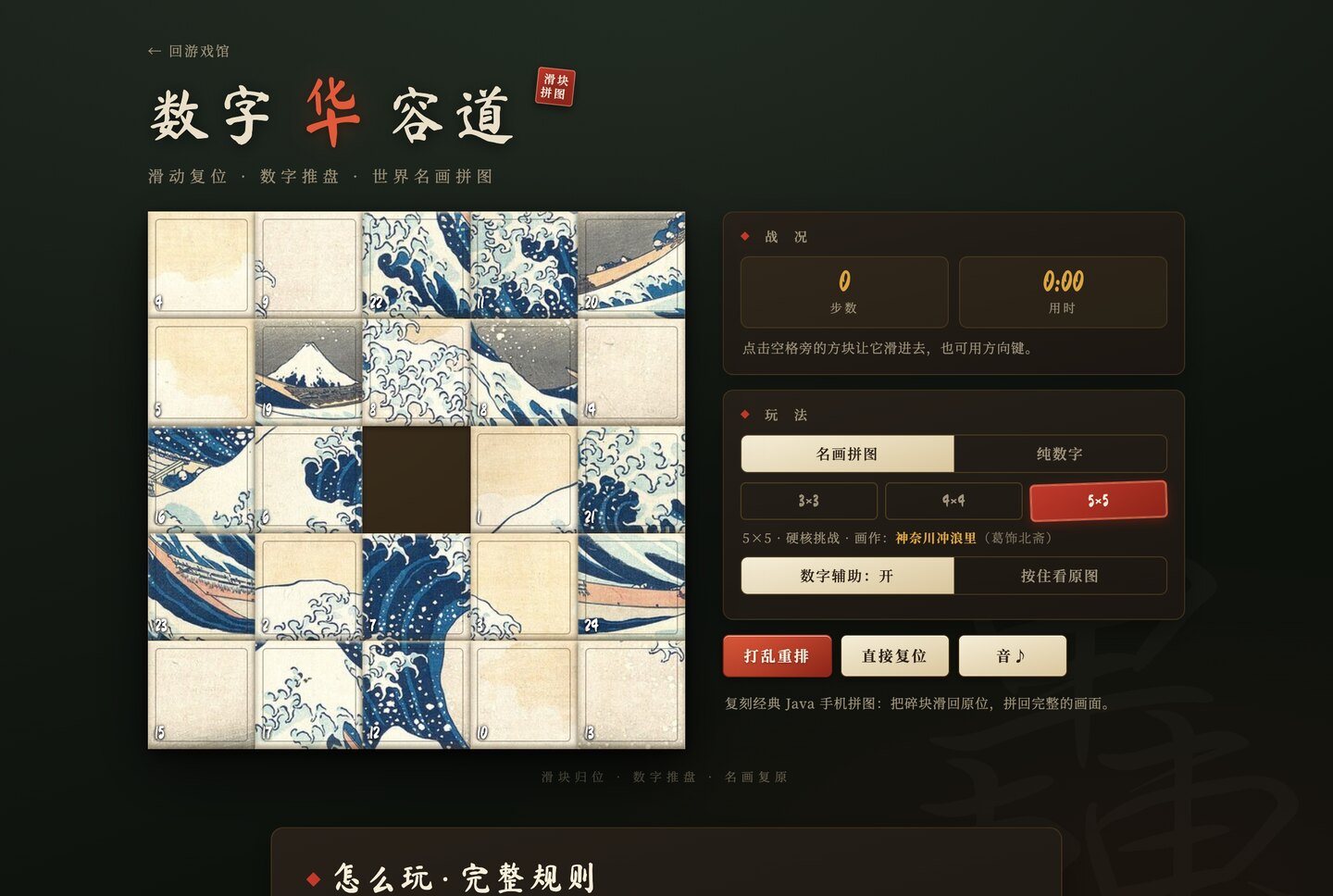
On top of that, every size comes with a different world-famous painting: the Mona Lisa for 3×3, Van Gogh's The Starry Night for 4×4, and Hokusai's The Great Wave off Kanagawa for 5×5, all using public-domain originals.

The 5×5 version, with that giant wave curling toward Mount Fuji, chopped up and then pieced back together, is genuinely a little addictive.
Nobody likes reading rules, so just "follow the taps"
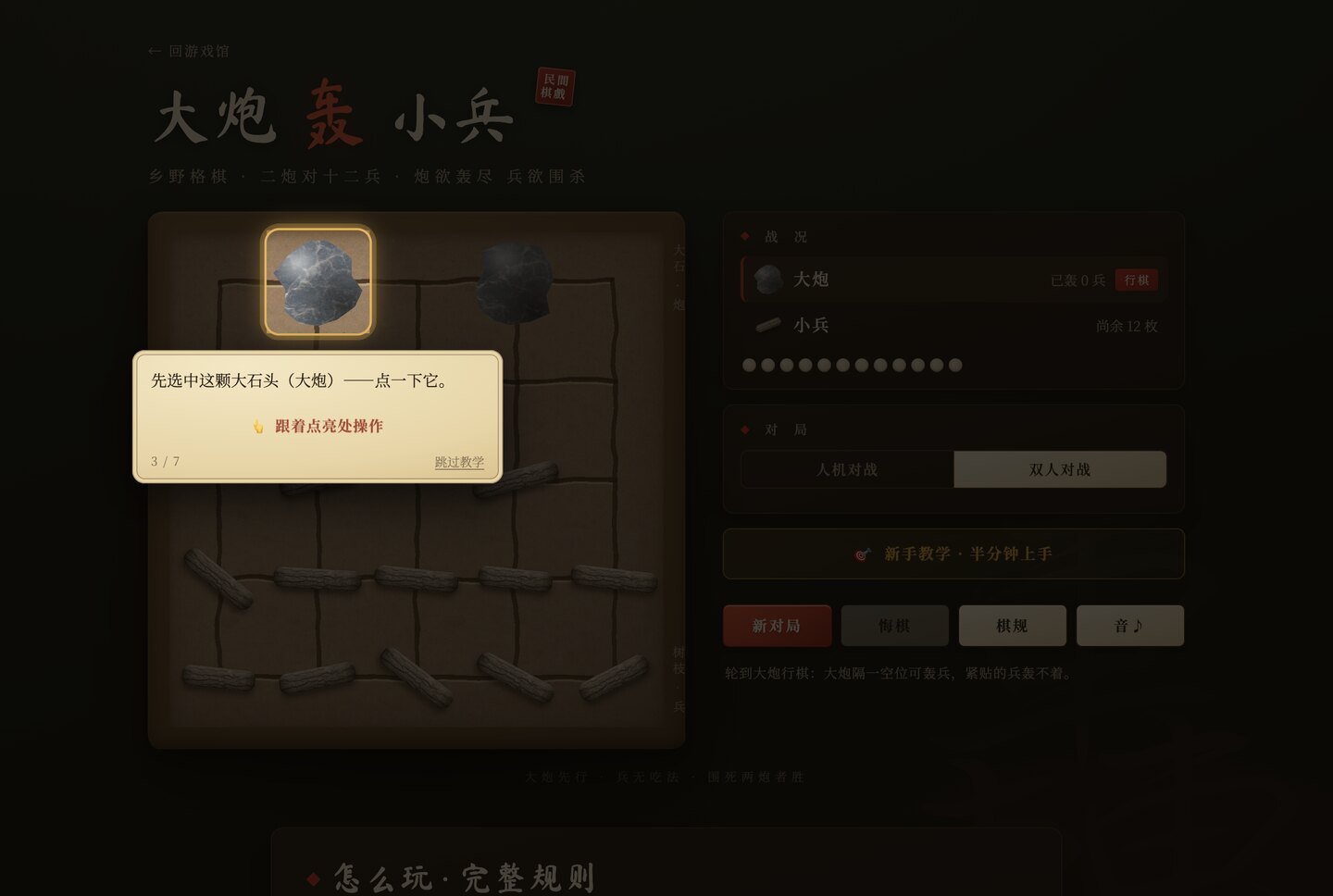
I do not like reading instructions myself. So I did not expect anyone to read the rules for these games. Instead I built a new-player tutorial like the ones in Honor of Kings (a hugely popular Chinese mobile game): the background dims, a spotlight highlights the next step, and it walks you through tapping along: select this big stone, then blast away a soldier with your own hand. In half a minute, you have learned it just by playing.
Obsession four: better fewer than filler
Along the way I added several games in one go, but three of them did not meet my standard when I played them myself, so I pulled them without hesitation. I would rather the hall grow slowly than fob people off with filler. Every game in it has to be one I would happily play again and again myself.
Closing thoughts
I made this for no other reason than to keep these "games scratched into the ground" from being lost with our generation. What they hold is waiting by the roadside on the way home from school, a grandfather and grandchild arguing red-faced over whether one sheep lives or dies, and that bit of village wisdom about how you can have a great time without any money.
If you played these games too, and still remember what they were called in your hometown, and how many tigers and sheep and what kind of board you used, I would love to hear about it, so one more name for the game can be kept.
The game hall will keep growing.
Come and play: youxi.pomodiary.com
Keep reading
- Five Traditional Folk Board Games: Rules, Strategy and a Little History
How to play Tiger and Goats, Cannons and Soldiers, Watermelon Chess, Jungle and Gomoku, with beginner strategy tips and brief notes on their history.
- I Turned Watching Ants Haul Insects as a Kid into 20 New Game Levels
Crumb Colony chapter six adds 20 insect levels where the key box hides deep in the tray. How I used bots to build levels you cannot solve by logic alone.
- A 100K-Download App Sat Quiet for Two Years. After a 13-Day Revamp, It Started Earning Again
Pomodoro Diary had 100K+ downloads but no real update in a year or two. We merged 53 PRs in 13 days to rebuild it, and paid orders started coming back in.